Pool Deck Resurfacing for San Marcos Heat, Clay and Chlorine
Pool deck resurfacing means bonding a new surface to the concrete around an existing pool. That deck gets bare feet, splash-out and August sun, and it sits on moving ground right beside a pool that doesn't move with it. There are three honest ways out of a worn deck:
-
Coat the deck
The slab is sound and the top is tired. A cement topping or acrylic coat renews the surface, and the joint gets redone with it.
-
Cover the slab
A thicker overlay or thin pavers change the look completely, as long as the extra height works at the coping, doors and drains.
-
Replace the concrete
The slab is broken, heaved or drains at the house. No coating fixes that, so the failed concrete comes out.
Where we stand: San Marcos Concrete Services doesn't resurface or repair pool decks, and we don't build pools or touch coping, tile or pool plumbing. We have no coating to sell you. Everything here comes from manufacturer instructions and published guides, credited as we go, so you can pick a route and question a bid.
How a Pool Deck Is Built: Slab, Coping and the Joint Between Them
Most deck problems start at one line: the seam where the deck slab meets the coping on top of the pool wall. The two are built to move apart, so whatever goes on the deck has to leave that seam working.
Why the joint matters here. A Dallas pool company puts it simply: coping and deck "need a space to expand and contract," and water that gets in through a failed seal "can cause soil movement and cracks." On the Blackland side of San Marcos that risk is real. USDA's Houston Black description has the clay splitting open for 90 to 150 days in most years, so a soaked strip beside the pool sits next to baked ground a few feet away. The deck is a thin slab riding on that soil, while the pool is a heavy separate structure. West of the escarpment, USDA's Comfort series puts limestone 10 to 20 inches down, but a pool dig means backfill around the shell, and fill is what settles on those lots.
A Texas yardstick. The state's rule for artificial swimming lagoons, 25 TAC §265.155, requires "continuous watertight expansion joint material" between decks and coping and says open gaps over 3/16 inch, or height changes over 1/4 inch, must be corrected. That rule covers lagoons over 20,000 square feet, not your backyard, and the state's public pool rules exclude residential pools. It's still a fair measure of what a sound joint looks like.
Pool Deck Resurfacing Options: Cool Deck, Acrylic, Knockdown, Pavers
Names get mixed up in this trade. "Cool deck" can mean a brand, a cement topping or a paint, so pin down the product before comparing prices.
Keystone Kool Deck: a 1/8-inch cement topping
Mortex, the Tucson company that makes it, sells a powder mixed with white cement and marble sand, then splashed on with a dash brush, troweled into a texture that's about 40% smooth and 60% void, and cured under plastic for exactly two days. Mortex "highly recommends a trained crew of 4 – 5 people." On existing concrete it needs bonding agent, an acid wash, and a deck stripped of every old topping. It's a real construction job, not a weekend coat. Cool deck resurfacing of an old topping starts with removing that topping.
Suits: a sound slab, an owner who wants heat relief first, and a job scheduled around the cure.
Acrylic pool deck coating: a rolled paint film
A water-based coat over textured concrete or old Kool Deck. Ramuc's guide calls for 1.6 to 2.3 mils dry per coat, two days of cure outdoors, and an extra day for each day of rain. National Pool Finishes says to add sand or pumice stone for a non-skid surface. It's the cheapest way to change color and the least able to hide damage. Ramuc warns its coat won't adhere over concrete sealers.
Suits: a faded deck with good texture and no open cracks, on an owner willing to recoat.
Spray deck and knockdown texture: about 1/8 inch
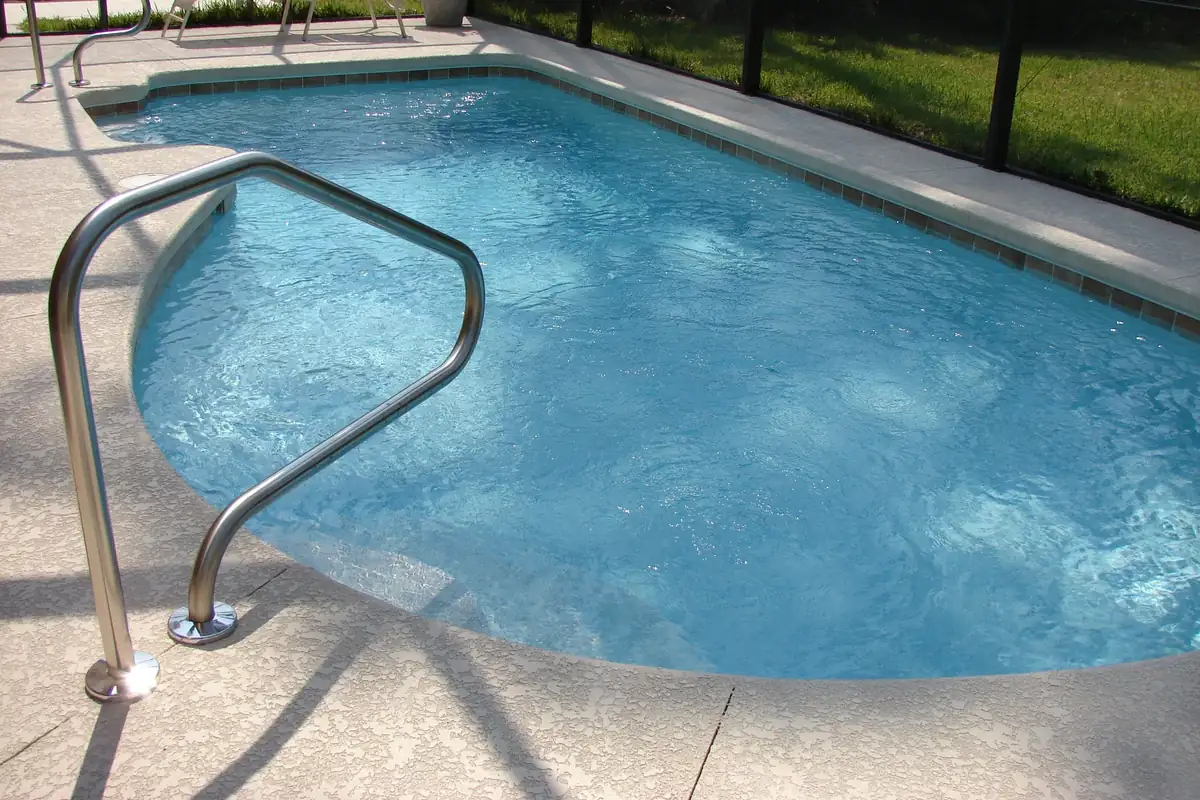
A polymer cement mix sprayed on and flattened with a trowel, in the class HomeGuide lists at about 1/8 inch. A knockdown pool deck is what most people picture: a pale mottled texture like the one in the photo below. It hides small blemishes, gives grip, and can be tinted light. The overlay types and their limits are covered in our concrete resurfacing guide. Get the data sheet for the exact product, because we couldn't find one published that's specific to pool deck knockdown.
Suits: a worn or patched slab that's flat and stable, where a uniform new look matters.
Stamped overlay on the old deck
HomeGuide's table puts stampable overlays at 1/4 to 3/4 inch, which is enough height to matter at the coping lip and any door. It also bonds to the slab's existing joints and cracks. Around water, ask how the texture and the sealer will grip when wet. More on that choice in the stamped section further down.
Suits: a sound deck with room to rise, where the pattern is the point.
Thin pavers over the old deck
The Concrete Masonry & Hardscapes Association's guide spec covers thin "tile" pavers 3/4 to 2 inches thick as a "rehabilitative overlay on concrete pool decks," for foot traffic only, on sand 1/2 to 3/4 inch thick or directly on smooth concrete, with edge pavers set in mortar or adhesive. Unilock calls poor drainage "the most common risk" of pavers over concrete; contractors often drill small drain holes through the slab. The slab still has to be stable: Unilock says wide gaps, heaving or rocking sections mean rebuilding instead.
Suits: a deck with hairline cracks and enough height to spare, on an owner who likes that one paver can be lifted later.
| Kool Deck | Acrylic coat | Knockdown | Stamped overlay | Thin pavers | |
|---|---|---|---|---|---|
| Added height | 1/8 in (Mortex) | A paint film | About 1/8 in | 1/4–3/4 in | 3/4 in up to about 2¾ in |
| Heat underfoot | Made for it; see heat section | Light colors help; no cooling claim | Depends on color | Depends on color | Light colors stay cooler (Unilock) |
| Grip when wet | Rough texture | Needs sand or pumice added | Rough texture | Sealer can make it slick | Ask for the wet rating |
| Hides a crack | No | No | Small blemishes only | Moving cracks return | Pavers float over hairlines |
| Patch blends in | Color is hard to match (KTAR) | Recoat the whole area | Ask | Hard to match | Swap the paver |
Read across for your priority: green cells are where a finish does well, red where it falls short, amber where the product decides. Named cells carry their source; the others are trade judgment. Paver height adds CMHA's unit and sand thicknesses.
Pool Deck Repair: What's Failing on Your Deck?
Open the one that looks like yours. Green edges are cosmetic; red ones mean the slab or the pool needs a look before anyone coats anything.
Fine web of hairline cracks in the topping Cosmetic
- Means
- Craze cracking. Mortex ties it to a topping mix that's too thick.
- Fix
- Usually leave it, or recoat when the look bothers you. It isn't a structural sign.
Coating peeling in sheets or chalky patches Bond failure
- Means
- It lost its grip, often over a sealer, dirt or paint left behind. Mortex's system "will not adhere" to concrete that isn't free of those. On salt pools, the American Society of Concrete Contractors describes water getting under the film.
- Fix
- Strip the loose coat back to clean concrete. A new layer on a failed one fails with it.
Sealant at the coping cracked, shrunken or pulled away Reseal soon
- Means
- Normal aging. ASP's Dallas office says mastic typically dries out or separates about every 3 years.
- Fix
- Old sealant out, joint clean and dry, new pool-rated sealant in. This is the cheapest repair on the deck, so don't let it slide. Details below.
One crack across the deck, edges level Rout and seal
- Means
- Usually shrinkage or a missing joint. Pool deck crack repair starts by watching it through a dry spell.
- Fix
- A stable crack is opened and sealed flexibly. It will show through any thin coating, and Mortex wants major cracks repaired "well in advance."
A section dropped, tipped or rose Fix the slab
- Means
- The ground moved: clay, washed-out backfill, a leak or a root. Water now runs the wrong way.
- Fix
- Find the water first. A whole panel that sank may be raised; our concrete leveling guide covers when that works (we don't lift concrete). Broken or heaved sections get replaced.
Deck drain clogged, cracked or sitting high Clear it first
- Means
- Water sits on the deck or goes under it. A low spot around a drain is often a settled section.
- Fix
- Flush it, then pour water and see where it goes. A plumbing leak is a job for a pool plumber. Any overlay also has to lift the grate; CMHA calls out adjusting drain inlets for a raised surface.
Loose coping, popped tile, or the deck pressing on the pool Pool pro first
- Means
- ASP lists falling tile and deck heaving as signs of a failed joint. The deck may be pushing on the bond beam, or water may be working behind it.
- Fix
- Have a pool contractor check the beam and coping before any deck coating. We don't do this work. HomeGuide warns bond beam repairs add to any coping job.
The Coping Joint: Mastic, Backer Rod and What a Coating Must Leave Open
From W. R. Meadows' Deck-O-Seal data sheet (May 2025): sold for "sealing joints on swimming pool decks subject to movement." A 2:1 width-to-depth ratio, sealant depth never under 1/4 inch or over 1/2 inch, joints at least 1/4 inch wide, clean and dry. Backer rod controls the depth. It stretches or compresses up to 25%, applies at 40–122°F, and needs 24 hours at 77°F before rain. Don't paint over it, and don't put it on asphalt-impregnated filler.
Sources: W. R. Meadows data sheets (Deck-O-Seal #787, Gun Grade #785, One Step #788), ASP Dallas, "What is Pool Mastic?" (2020).
Three things follow for anyone resurfacing:
- The coating stops at the joint. Mortex tells crews to cover joints and drains with tape. A topping bridged across the seam just cracks along it.
- Sealant goes in last, on clean sides. Since the sealant can't be painted over, an acrylic coat that needs recoating has to be cut in around it. Ask what order the bid uses.
- A hairline seam isn't a joint. If the gap is under 1/4 inch, there's no room for sealant to work, and a data sheet can't save it. Someone has to decide whether to cut it wider, and that's a call to make with care right beside the coping.
Cantilevered decks work differently. ASP notes the deck runs over the pool wall there, so mastic may only appear at the control joints in the concrete. If yours has no seam at the coping, don't let anyone cut one without a pool contractor's say-so.
Is Your Pool Deck Too Hot? Surface Heat and Bare Feet
NOAA's normals put San Marcos's average high at 96.8°F in August. That's over the 95°F line in a UNLV burn study: of 173 pavement burns treated in Las Vegas, more than 88 percent happened at 95 degrees or higher. Those are desert numbers on street pavement, not a pool deck, but they show how fast a sunlit slab outruns the air. The study estimated pavement at 147 degrees on a 111-degree day, and the EPA cites an Arizona pilot where conventional paving hit 152°F at midday while cool pavements stayed 10 to 16°F cooler.
How much a pool deck product helps is harder to pin down, and that's worth saying plainly:
- Kool Deck. Mortex says it "significantly lowers the surface temperature of concrete" and gives no number. Rosie on the House, an Arizona home show, says around 20 degrees and cites no test. Acrylic textured coatings, the same piece says, run cooler than plain concrete but not as cool as Kool Deck.
- Paint on Kool Deck. Mortex: Systex paint "does NOT provide cooling properties."
- Pavers. Unilock, which sells them, says pavers are the coolest surface; Rosie on the House says they "can get very hot." Unilock's own FAQ agrees that both pavers and concrete get hot and that color is what counts.
- Color. The one point everybody shares. Fixr warns that dark materials "make the pool area deck very hot to the touch."
We found no independent side-by-side test of pool deck finishes, so take every "degrees cooler" claim as a sales claim. There's a better way to choose: ask each bidder for a sample board, leave them in full sun next to your deck on a clear afternoon, and read them with an infrared thermometer. Then stand on them.
Slip Resistance, Chlorine and Salt Water on a Pool Deck
Grip on a wet deck
Texture does most of the work, and sealer can undo it. A contractor quoted in Concrete Decor put it this way: "Anytime we seal concrete around swimming pools, we increase the slipperiness." Mortex warns that paint turns its surface "hotter and slicker." For a number to ask for, the state's lagoon rule requires a slip-resistant textured finish meeting ANSI A137.1-2012's dynamic coefficient of friction. It's written for lagoons and tile-style testing, but "what's your wet rating?" is a fair question. If nobody can answer, a wet sample and a bare foot are your test. Standing water matters too: Fixr's fall of 1/4 inch per foot away from the pool is what keeps it moving.
Chlorine and pool chemicals
Manufacturers say these products resist pool chemicals: Mortex for Kool Deck Elite and Systex, National Pool Finishes for Deck Kote, and Unilock for pavers. Spilled concentrate is another matter. Mortex says to rinse any concentrated muriatic acid or chlorine off "thoroughly and immediately," and tells owners not to attempt acid washes themselves.
Salt water pools
The American Society of Concrete Contractors says problems typically start "around a control joint or where the concrete slab meets the pool coping," which is one more reason to keep that joint sealed. Whether salt is really the culprit is argued in the trade; in Concrete Decor's 2014 report one expert put failure at two years or more, another at 4 to 5 months. The maintenance advice doesn't vary: rinse with fresh water. Mortex calls that "essential" with a salt water chlorinator. Check the current drought stage for how you can do that (below).
Freeze and thaw
San Marcos's average January low is 38.9°F, so it's a minor factor most years, but the February 2021 storm showed it can happen. ASP warns that water trapped in an open coping joint can freeze and damage tile, coping and the pool beam. A sealed joint protects against that too.
Resurface or Replace a Pool Deck? Check the Slab First
HomeGuide's test is a fair one: resurfacing beats replacing "as long as the existing concrete is in mostly good condition and the subbase is stable." Mortex's system needs "clean, sound concrete." Walk the deck with a hammer, a level and a hose, and tick whatever is true:
- Hollow spots and old stacks. Everything bonded to a loose layer leaves with it. Coatings get stripped back to sound concrete, and at some point the stripping costs more than it saves.
- Moving cracks and sunk sections. A thin topping follows the slab. Our concrete leveling guide covers lifting; a section that's broken is cut out and replaced.
- Wrong-way drainage. A coating copies the slope under it. A deck that drains at the house or into the pool needs the slab changed.
- Coping contact or an unexplained leak. Call a pool contractor or a leak-detection company first. Pressure from a deck on the pool, or water under the slab, will undo any surface work.
If the flatwork has to go, this is where we can be useful, within limits. Replacing failed flatwork with new concrete is work we do: a new concrete patio slab on a prepared base, with a finish chosen for grip. We don't work on the pool, coping, tile or plumbing, so that side of the job needs someone who does. For ordinary flatwork elsewhere on the property, see concrete repair. On a lot inside the Edwards Aquifer Recharge Zone, remember a bigger deck adds impervious cover; our patio page has the city's caps and a calculator.
Pool Deck Resurfacing Cost: Published Prices by Finish
These are national figures from published guides, credited line by line. We don't do this work, so none of them is our price and we can't quote it. They're here to help you check a bid.
| Pool deck item | Published range | Source |
|---|---|---|
| Pool deck resurfacing, per sq ft | $3–$12; $1,500–$10,800 for 500–900 sq ft | HomeGuide, July 2025 |
| Basic pool deck overlay | $3–$6 per sq ft | HomeGuide, July 2025 |
| Decorative pool deck overlay | $6–$12 per sq ft | HomeGuide, July 2025 |
| Stamped finish over a pool deck | $7–$20 per sq ft | HomeGuide, July 2025 |
| 750 sq ft deck: basic / decorative / stamped | $2,250–$3,750 / $5,250–$9,000 / $6,000–$15,000 | HomeAdvisor, June 2026 |
| 18-inch pool border (135 sq ft) | $400–$800 | HomeGuide, Feb. 2026 |
| 4-foot pool border (360 sq ft) | $1,100–$2,200 | HomeGuide, Feb. 2026 |
| Kool Deck coat, added to the deck | $4–$6 per sq ft; $4 in a second guide | HomeGuide, 2025 and 2026 |
| Cool deck topping, hot climates | about $4 per sq ft extra | HomeAdvisor, June 2026 |
| Epoxy pebble or similar deck flooring | $4–$10 per sq ft | HomeGuide, July 2025 |
| Paver pool surround | from about $20 per sq ft | Unilock (manufacturer) |
| Rubberized coating over a pool slab | $8–$14 per sq ft | Fixr, Jan. 2025 |
| Mastic job, Dallas minimum | $560 (2020 figure) | ASP Dallas, one company |
| Replacing pool coping | $40–$80 per linear ft | HomeGuide, Jan. 2026 |
| New concrete deck, 12×24 ft pool | $6,750–$8,000; $6–$10 per sq ft | Fixr, Jan. 2025 |
| New stamped pool deck | $15–$30 per sq ft | Fixr, Jan. 2025 |
The guides disagree, so don't treat any row as firm. HomeGuide lists a $150 minimum and a $15,000 maximum, with a $6,200 national average. Its general resurfacing guide prices pool decks at $3 to $6, its pool deck guide at $3 to $12, and those are likely describing different scopes. What raises a real bid: removing old toppings, the amount of crack and joint repair, curved pool shapes, access through the yard, and the pattern. HomeGuide also says fall and winter can bring discounts, which here is when the weather cooperates anyway.
Links: HomeGuide pool deck resurfacing cost, HomeGuide concrete resurfacing cost, HomeAdvisor concrete resurfacing cost, HomeGuide pool coping cost, Fixr pool deck cost, Unilock pool deck design.
Stamped Concrete Around a Pool: Thin Layer or New Pour?
"Stamped concrete around a pool" can mean two different jobs, and the slab decides which. A stamped overlay is a thin bonded layer on the concrete you already have, so it keeps that slab's joints, cracks and drainage. A new pour takes the old slab out and presses the pattern into fresh concrete on a rebuilt base.
The price gap is smaller than people expect. HomeGuide's overlay range starts at $7 and reaches $20 per square foot; Fixr's new stamped pool deck range is $15 to $30, before any demolition. On a slab that's moving, paying near the top of the overlay range is hard to justify.
We don't install overlays and don't work on the pool or coping. For new decorative flatwork in general, including the exposed aggregate finish that gives good grip wet or dry, our stamped concrete page compares the finishes. For any overlay, the concrete resurfacing guide explains why they fail on moving slabs.
How a Pool Deck Gets Resurfaced: Prep, Coats and Cure
Pool deck prep is harsher than most homeowners expect. This sequence follows Mortex's Kool Deck instructions for existing concrete, with notes where acrylic makers differ. Follow your own product's sheet, because they don't all agree.
- Weeks ahead
Fix the deck and its drainage
Mortex wants major cracks and structural damage repaired "well in advance." Failed sections and bad drains come first.
- Day 1
Mask the pool edge, joints and drains
Mortex covers joints and drains with tape and masks aluminum, which cement will corrode and blacken. Protect the water and tile too.
- Day 1
Strip every old coating
A scarifier takes off toppings, then a pressure washer. Mortex allows a 3,000 psi washer to remove paints, adhesives and polymer toppings.
- Day 1
Acid wash the deck, then rinse
Wet the deck first, then scrub with muriatic acid: 1 to 1 with water on old concrete, per Mortex. If it doesn't fizz, something is still on the deck. Mortex says never to neutralize with TSP, which breaks the bond; Ramuc's acrylic process uses TSP. That's why you follow one sheet, not a blend.
- Day 2
Bonding coat on a wet deck
The deck stays wet for at least an hour, then the bonding agent is scrubbed on and never allowed to dry before the topping.
- Day 2
Splash twice, then trowel
Two passes with a dash brush, down to 1/8 inch, then a flat trowel. Mortex says Kool Deck can't go through a hopper gun.
- Next 2 days
Cure under plastic
Covered immediately, section by section, for exactly two days. Acrylic coats instead want two days dry, plus a day for each day of rain (Ramuc).
- Next 4 weeks
Stay off, then seal the joint
Light walking after 3 days, normal walking after 14, heavy furniture after 28 (Mortex). The tape comes off and the coping joint gets its new sealant on clean, dry sides.
Pool Deck Work Under San Marcos Heat, Rain and Water Rules
Published application limits. Kool Deck: ambient "50 degrees and rising and should not be over 90," with extreme care if it will top 95°F, and no application if rain or frost is predicted. Ramuc acrylic: ideally 50–90°F air, surface at least 50°F, not with rain imminent. Deck Kote: not below 50°F or above 95°F. Deck-O-Seal: 40–122°F.
Sources: Mortex, Kool Deck on Existing Concrete, Ramuc Acrylic Deck Coat guide (1/07), National Pool Finishes Deck Kote.
Heat. NOAA's normals put the average high over 90°F from June through September, so a mid-afternoon application in those months is out of range before you count the hot slab. Summer jobs belong at first light, if at all.
Rain and cold. May and October are the wettest months in those normals, and every sheet above cares about rain. The January average low of 38.9°F means winter work waits for the day to warm up. Spring and fall give the most usable days, with a close eye on the forecast. Kool Deck's two days under plastic and Ramuc's extra rain days make a tight forecast a real problem.
Drought rules can stop this job. As of November 1, 2026, the city's conservation page says San Marcos is in Stage 3, where "filling swimming pools, and washing impervious surfaces are all prohibited," and letting water run off a property is waste in every stage. Every process on this page starts with a pressure wash, and Mortex wants the deck washed frequently for 28 days. Older city code had a health-and-safety exception for surface washing; we couldn't confirm it still stands or that it would apply here. So before you schedule anything, ask the city's conservation staff how the rule applies. If they say no, the job waits for a lower stage. The same goes for any acid rinse: ask where it can go, because it shouldn't run to the street.
Permits. We found no city page on resurfacing a pool deck. The Permit Center lists pools and decks among the projects with application requirements, and for an unclear case it suggests a Permit Determination Form (512-805-2630, permitinfo@sanmarcostx.gov). On the Edwards Aquifer recharge zone, TCEQ's rules leave resurfacing existing paved surfaces out of regulated activities when there's no added disturbance (30 TAC §213.3). Your HOA may have its own rules on color and finish.
Pool Deck Resurfacing Near Me: What to Ask Any Contractor
We can't be your bidder on this one. Whoever you call, these questions separate pool deck specialists from painters with a sprayer.
| Ask | A real answer | Keep looking if… |
|---|---|---|
| Which product and system? | Brand, name, data sheet, and whether it's a topping, overlay or paint | "It's basically Kool Deck" |
| What happens to the old coating? | Removal method, and what happens if it won't come off | "We'll go right over it" |
| How is the coping joint handled? | Old sealant out, joint width checked, named sealant, backer rod, done in the right order | The coating runs into the coping |
| Which cracks get fixed, and how? | Marked on a sketch, with a plain statement that moving cracks can return | "The coating will cover it" |
| How much height does it add? | A number, checked at the coping lip, doors and drains | No measurement taken |
| How will it grip when wet? | A wet sample you can stand on, or a published slip rating | "It's non-slip" and nothing else |
| How does prep fit the drought stage? | Has an answer from the city on washing and rinse water | Hasn't heard of the stage |
| What protects the pool during prep? | Masking, and how acid and dust stay out of the water | Not considered |
| Does your warranty cover peeling at the joint? | Written terms, what's excluded, how long | A verbal promise |
HomeGuide's advice to compare at least three estimates fits here, since these bids can describe very different work under the same name. For the concrete we do pour, our concrete contractor home page lists it all.
DIY Pool Deck Coating: Paint, Patches and Sealant
A rolled acrylic recoat is the one surface job a careful owner can do. Ramuc's numbers set the scale: 125 to 150 square feet per gallon on bare or rough surfaces and 250 to 300 on recoats, with a roller nap no thicker than 3/8 inch. It's still a lot of prep: power wash, scrub, etch, and rinse, and Ramuc says not to spray it. Remember Mortex's warning that the owner shouldn't attempt muriatic acid washes on Kool Deck, and check the drought rule first.
Resealing a coping joint is also within reach if the joint is wide enough. The hard part, by the accounts we've read, is getting the old mastic out; the data sheet's clean, dry joint and 2:1 shape are what decide if it lasts. A cheap tube from a general store shelf is not the same as a pool-rated sealant.
Leave Kool Deck-type toppings alone. Mortex's instructions call for a paddle mixer, a viscosity cup, and that crew of four or five. The same goes for anything on the coping, tile or bond beam. And if you're tempted by a clear sealer as a quick refresh, remember that it can make a wet deck slicker and that Ramuc's coat won't stick to one later.
Cool Deck and Pool Deck Repair Questions
Do you resurface or repair pool decks?
No. We don't apply cool deck, knockdown, overlays or deck coatings, we don't repair cracks or coping joints on pool decks, and we don't build pools or work on coping, tile or pool plumbing. If an old deck is past saving, new flatwork is the part we can talk about: a new concrete patio slab, or an exposed aggregate or stamped finish. This guide is here so you can judge any pool deck bid on your own.
Is Kool Deck the same as an acrylic deck coating?
No. Keystone Kool Deck is a cement-based topping: Mortex's instructions mix it with white cement and marble sand, splash it on and trowel it to 1/8 inch. Acrylic deck coats are paints, rolled on in films measured in thousandths of an inch. "Cool deck" gets used for both, so ask which one a bid means.
Can you paint over Kool Deck?
You can, and paint makers sell products for it, but know the trade-off. Mortex says plainly that its own Systex deck paint gives no cooling and that a painted Kool Deck surface "will become hotter and slicker." Paint also commits you to repainting, and Ramuc notes its coat won't adhere over concrete sealers.
How long does pool deck resurfacing last?
We found no independent life figure for pool deck finishes specifically. HomeGuide gives concrete resurfacing in general 8 to 15 years before repairs are needed. The joint around the coping needs attention far sooner: a Dallas pool company says mastic there typically dries or separates about every 3 years.
Does a salt water pool ruin a concrete deck?
The trade is split. The American Society of Concrete Contractors describes salt water getting under a sealer at control joints and at the coping, then attacking the concrete beneath. Others in the 2014 Concrete Decor report doubted there's a problem at all, and noted that nobody has pinned down the mechanism. Everyone agrees on the cheap part: Mortex calls it "essential" to rinse and clean a deck frequently if you have a salt water chlorinator.
Does Texas have a rule for residential pool decks?
Not in the state's public pool rules. 25 TAC §265.182 excludes residential pools, meaning those serving a single-family home or duplex. Apartments, hotels and HOA pools are covered. For a house, ask the city what applies: Planning & Development Services takes questions at 512-805-2630 or permitinfo@sanmarcostx.gov.
Looking for new concrete instead?
We don't resurface or repair pool decks, and we don't work on pools, coping, tile or pool plumbing. If you need a new patio, walk or other flatwork poured, send the address, what you have in mind and a few photos.